
Choosing natural stone: beauty, performance and the way it ages
What to consider before selecting stone for floors, walls, counters and exterior use.
- Written by
- The MIYAAR studio
- Published
- Last reviewed
- Reading time
- 9 minutes
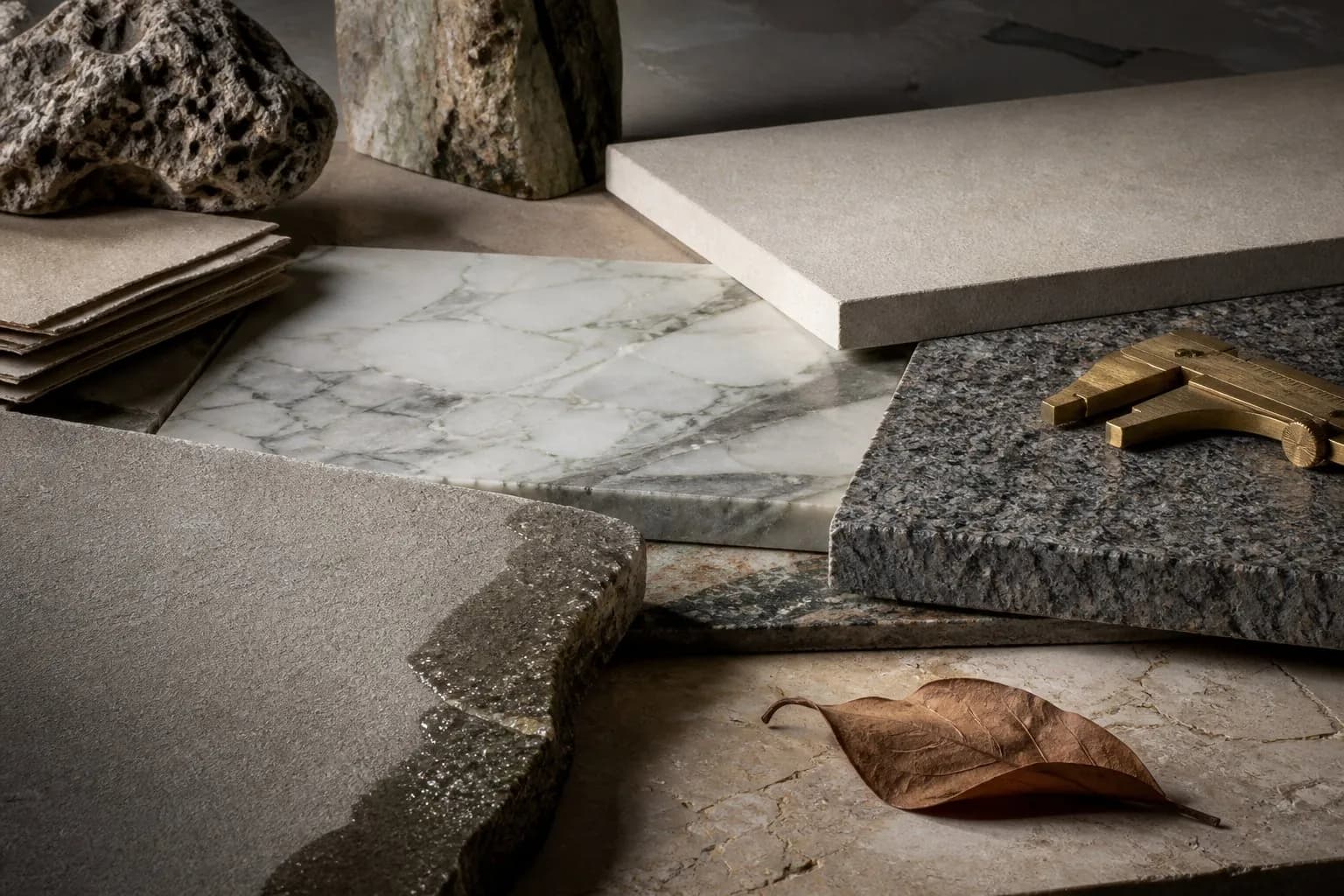
Choose stone by porosity, hardness and finish rather than by appearance. Porosity determines staining and sealing, hardness determines scratching and etching, and finish determines slip resistance and how visible wear becomes. Appearance chosen without those three is the most common and most expensive material error in Indian homes.
Stone is selected in a showroom, under bright light, on a polished 300 mm sample, wet. It is then lived on for thirty years, dry, underfoot, in daylight. Almost every stone regret traces back to that mismatch.
The three properties that actually decide it
Porosity
How much liquid the stone absorbs. High porosity means staining from oil, turmeric, wine and water, and it means sealing on a schedule. Test it before you commit: place a few drops of water on an unsealed sample and watch. If the patch darkens within minutes, that stone will absorb whatever your household spills.
Hardness and acid sensitivity
Calcium-based stones — marble, limestone, travertine — react with acid. Lemon, vinegar, tamarind, curd and many household cleaners will etch them, leaving a dull mark that is chemical damage rather than a stain and cannot be cleaned off.
Finish
The same stone in polished, honed, leathered or flamed finish behaves like four different materials. Polished is reflective, shows every scratch and is dangerous wet. Honed is matte, forgiving and hides wear. Leathered has texture and grip. Flamed is rough and belongs outdoors.
How the common choices actually perform
| Stone | Porosity | Best used for | Ages by |
|---|---|---|---|
| Granite | Very low | Kitchen counters, heavy floors, exterior | Barely changing |
| Marble | Medium–high | Low-traffic floors, vanities, vertical surfaces | Etching and patina |
| Limestone (incl. Kota) | Medium–high | Floors, courtyards, cladding | Softening and darkening |
| Quartzite | Low | Counters, high-traffic floors | Very slowly |
| Sandstone | High | External paving, cladding | Weathering and colour shift |
| Travertine | High | Interior floors, walls | Filling and pitting |
The questions to ask a supplier
- 01Can I see a full slab, not a sample? Veining varies enormously across a block.
- 02Is all of it from the same block and the same batch? Colour shifts between blocks are permanent and obvious.
- 03What is the water absorption figure? Ask for the number, not a reassurance.
- 04How thick, and what is the substrate build-up? Thickness affects both cost and how the edge reads.
- 05Can I take an unsealed offcut home? Spill on it for a week before deciding.
Ageing is a decision, not a defect
A limestone floor in a courtyard will darken along the paths people walk. Marble around a basin will lose its polish where water sits. Neither is a failure — both are the material recording how the house is used.
The decision worth making consciously is whether you want a material that records use, or one that resists it. Households that want stone to look identical in year fifteen should be specifying granite or quartzite and choosing the appearance within that constraint — not choosing marble and hoping.
Specify the stone your household actually lives like, not the one that looked best wet.
Questions this raises