
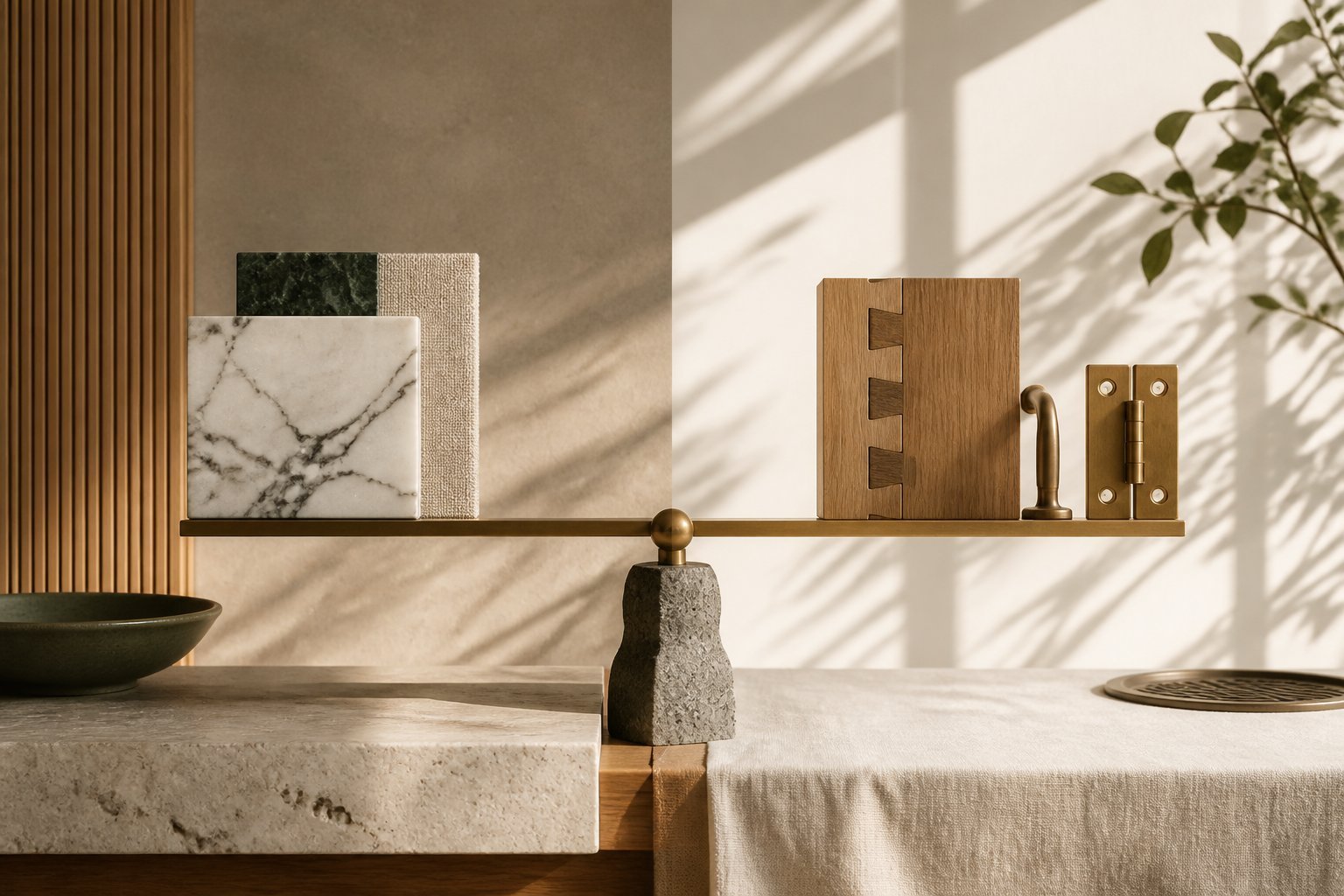
Price per square foot is useful for comparison, but it cannot explain why two homes of equal area may perform, age and feel entirely differently.
Area is not spatial quality
Circulation efficiency, daylight, cross-ventilation, privacy and the relationship between inside and outside affect daily experience more than raw area. A larger plan with weak proportions may create less usable value than a smaller, carefully organised home.
Visible finish is only one layer
Stone, timber and fittings are easy to notice. Waterproofing, services coordination, hardware, access for maintenance, acoustic control and the quality of concealed work are less visible but often more consequential.
Evaluate the life-cycle, not only the reveal
A material that looks impressive on handover may stain, warp or require specialist upkeep. Good value considers performance, repairability, replacement, local skill availability and how gracefully something ages.
A premium home earns its value through coherence, reliability and lived relevance—not the number of expensive objects it contains.
Ask better comparison questions
- What decisions improve daily life rather than the sales photograph?
- Which systems will be difficult to access or maintain?
- Are materials appropriate to climate and use?
- How complete is the information before construction begins?
- Who remains accountable when disciplines overlap?
Expense is what something costs. Value is what the project continues to give—and what it prevents you from having to repair, replace or regret.